Demo Kinaxis KX3-003 Exam Questions
Demo practice questions for guest users.
Question 1
You have a new demand for 800 units of a product. SourceRule.AllotmentRule for this part is set to OnGoing.
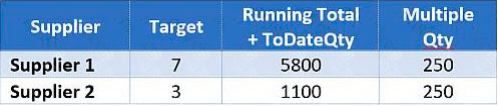
Referring to the graphic, which planned order results will be created to satisfy this demand?
Correct Answer: A
Explanation:
Referring to the graphic, it appears that there is a target allocation ratio between Supplier 1 and Supplier
Referring to the graphic, it appears that there is a target allocation ratio between Supplier 1 and Supplier
2 (not visible in the image, but this can be inferred from the allocation quantities). When a new demand
for 800 units is introduced, the SourceRule.AllotmentRule set to OnGoing will distribute the demand
based on the ongoing target ratio. Since Supplier 1 has a running total that far exceeds Supplier 2, and
both have a 'Multiple Qty' of 250, the next allotment will attempt to balance the ongoing total closer to the
target ratio. It's likely that the new demand will be allocated by filling up to the nearest multiple of 250
that does not exceed the demand. Therefore, Supplier 1 gets 250, and the remaining 550 units would go
to Supplier 2. Since Supplier 2 also must supply in multiples of 250, it rounds up to 750 units.
ReferencesThis understanding is derived from the Kinaxis RapidResponse concepts for managing
supply allocations and the behavior of ongoing rules as described in the Kinaxis RapidResponse
documentation.
References:
The Kinaxis RapidResponse documentation on SourceRule.AllotmentRule indicates that ongoing
allotment is based on the target ratios set for suppliers1.
The Certified RapidResponse Author Level 3 materials cover the configuration and implications of
SourceRule. AllotmentRule settings2.
Question 2
You need to create a new custom field to be used for record filtering that will be populated with the salesperson's name. Each order will have a single associated salesperson's name.
Following database design principles and Kinaxis best practices, which action accomplishes this task?
Correct Answer: B
Explanation: