Popular Vendors
Demo Microsoft DP-700 Exam Questions
Demo practice questions for guest users.
Question 1
You need to ensure that the data analysts can access the gold layer lakehouse.
What should you do?
Correct Answer: C
Explanation:
Data Analysts' Access Requirements must only have read access to the Delta tables in the gold layer
Data Analysts' Access Requirements must only have read access to the Delta tables in the gold layer
and not have access to the bronze and silver layers.
The gold layer data is typically queried via SQL Endpoints. Granting the Read all SQL Endpoint data
permission allows data analysts to query the data using familiar SQL-based tools while restricting
access to the underlying files.
Question 2
HOTSPOT
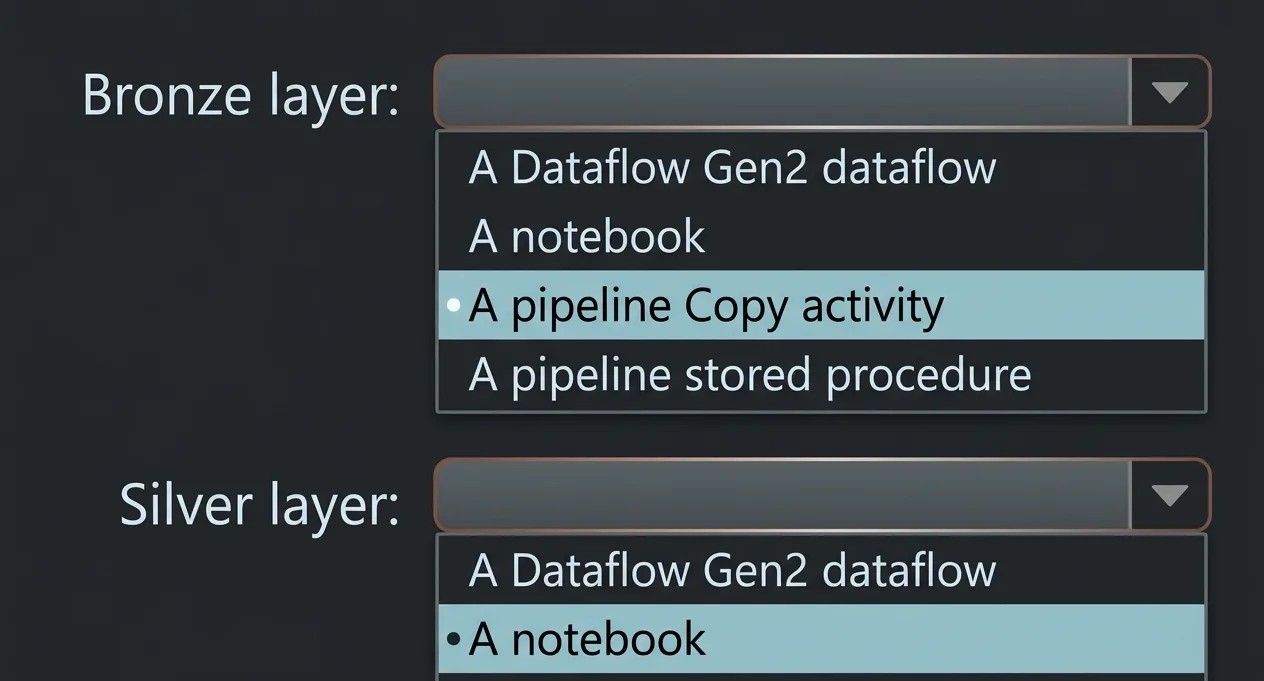
You need to recommend a method to populate the POS1 data to the lakehouse medallion layers.
What should you recommend for each layer? To answer, select the appropriate options in the answer
area.
NOTE: Each correct selection is worth one point.
Correct Answer: A
Explanation:
A screenshot of a computer Description automatically generated
A screenshot of a computer Description automatically generated
Bronze Layer: A pipeline Copy activity
The bronze layer is used to store raw, unprocessed data. The requirements specify that no
transformations should be applied before landing the data in this layer. Using a pipeline Copy activity
ensures minimal development effort, built-in connectors, and the ability to ingest the data directly
into the Delta format in the bronze layer.
Silver Layer: A notebook
The silver layer involves extensive data cleansing (deduplication, handling missing values, and
standardizing capitalization). A notebook provides the flexibility to implement complex
transformations and is well-suited for this task.
Question 3
HOTSPOT You need to meet the development requirements for the FeedbackJson column
How should you complete the Transact SQL query? To answer, select the appropriate options in the answer area. NOTE: Each correct selection is worth one point.
Correct Answer: A
Explanation: