Popular Vendors
Demo Microsoft GH-300 Exam Questions
Demo practice questions for guest users.
Question 1
You need to identify the cause of the performance issues on SalesSQLDb1.
Which two dynamic management views should you use? Each correct answer presents part of the
solution.
NOTE: Each correct selection is worth one point.
Correct Answer: A, E
Explanation:
sys.dm_os_wait_stats: for SQL Server
Incorrect Answers:
SalesSQLDb1 experiences performance issues that are likely due to out-of-date statistics and
frequent blocking queries.
A: Use sys.dm_pdw_nodes_tran_locks instead of sys.dm_tran_locks from Azure Synapse Analytics
(SQL Data Warehouse) or Parallel Data Warehouse
E: Example:
The following query will show blocking information.
SELECT
t1.resource_type,
t1.resource_database_id,
t1.resource_associated_entity
_id, t1.request_mode,
t1.request_session_id,
t2.blocking_session_id
FROM sys.dm_tran_locks as t1
INNER JOIN sys.dm_os_waiting_tasks as t2
ON t1.lock_owner_address = t2.resource_address
Note: Depending on the system you’re working with you can access these wait statistics from one of
three locations:
sys.dm_os_wait_stats: for SQL Server
sys.dm_db_wait_stats: for Azure SQL Database
sys.dm_pdw_nodes_os_wait_stats: for Azure SQL Data Warehouse
F: sys.dm_tran_locks returns information about currently active lock manager resources in SQL
Server 2019 (15.x). Each row represents a currently active request to the lock manager for a lock that
has been granted or is waiting to be granted.
Instead use sys.dm_pdw_nodes_tran_locks.
Incorrect Answers:
Question 2
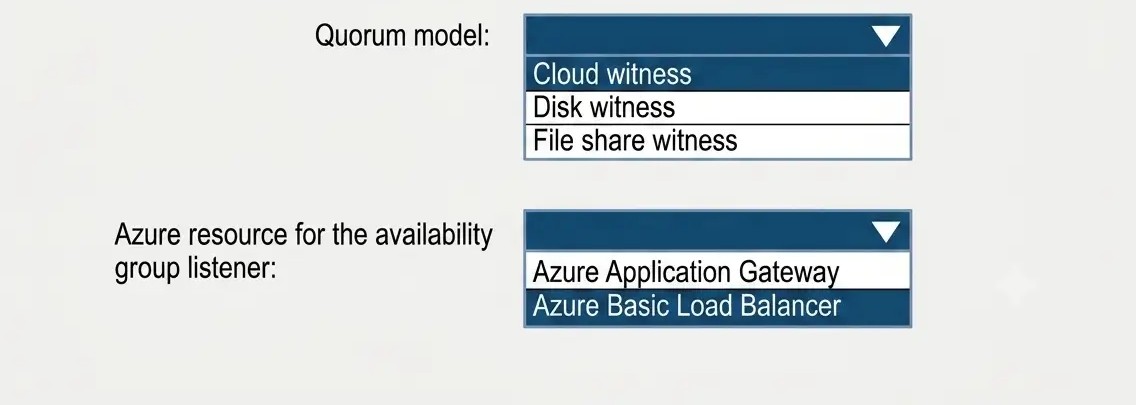
You need to recommend a configuration for ManufacturingSQLDb1 after the migration to Azure. The
solution must meet the business requirements.
What should you include in the recommendation? To answer, select the appropriate options in the
answer area.
NOTE: Each correct selection is worth one point.
Correct Answer: A
Explanation:
Note: There are two main options for setting up your listener: external (public) or internal. The
Scenario: Business Requirements
Litware identifies business requirements include: meet an SLA of 99.99% availability for all Azure
deployments.
Box 1: Cloud witness
If you have a Failover Cluster deployment, where all nodes can reach the internet (by extension of
Azure), it is recommended that you configure a Cloud Witness as your quorum witness resource.
Box 2: Azure Basic Load Balancer
Microsoft guarantees that a Load Balanced Endpoint using Azure Standard Load Balancer, serving two
or more Healthy Virtual Machine Instances, will be available 99.99% of the time.
Note: There are two main options for setting up your listener: external (public) or internal. The
external (public) listener uses an internet facing load balancer and is associated with a public Virtual
IP (VIP) that is accessible over the internet. An internal listener uses an internal load balancer and
only supports clients within the same Virtual Network.
Question 3
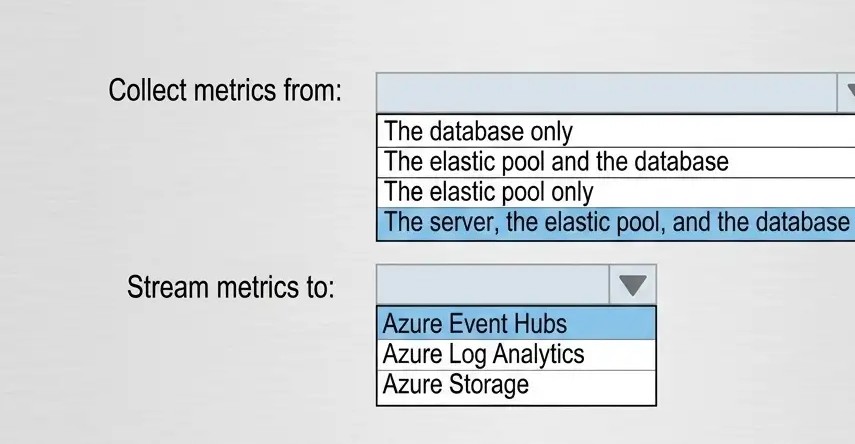
You need to implement the monitoring of SalesSQLDb1. The solution must meet the technical
requirements.
How should you collect and stream metrics? To answer, select the appropriate options in the answer
area. NOTE: Each correct selection is worth one point.
Correct Answer: A
Explanation:
Box 1: The server, the elastic pool, and the database