Demo The Open Group OGA-032 Exam Questions
Demo practice questions for guest users.
Question 1
Please read this scenario prior to answering the question ArchiAir Catering Services (ACS) manages the catering services for ArchiAir, a leading airline. ACS is the sole catering supplier for all ArchiAir flights, and its services include full provisioning to the aircraft. Currently, ACS operates three central production facilities, supported by distribution hubs and local pre-flight production facilities. The central production facilities are responsible for producing standardized non-food materials (such as plates, cutlery, and boxes), non-perishable food products, and key ingredients required by the local production facilities. These materials are subsequently distributed to the distribution hubs, which also serve as warehouses for the local production facilities. Within the local production facilities, multiple production machines are utilized, each featuring dedicated workstations for chefs and quality inspectors. Most of the local production facilities employ fully automated assembly lines, including built-in packaging stations. The loaded service trolleys are then transported to the aircraft using small lorries. In response to investor pressure for ArchiAir to reduce its carbon footprint, the CEO of ACS has announced a plan to address this environmental concern. Subsequently, the Ministry of Social Welfare and Health has enacted a law mandating a reduction in CO2 emissions from all production facilities by the end of the year. Additionally, the airline's decision to raise ticket prices due to escalating fuel costs has led to a decrease in passenger numbers. This, in turn, impacts the volume of non-food materials required from ACS. An intemal investigation has produced a report highlighting the potential benefits of centralizing production facilities and reducing the number of distribution centers. Such changes would result in lower CO2 emissions while still effectively meeting all the requirements of ArchiAir. In addition to evaluating its supply chain to reduce its carbon footprint, ArchiAir is taking proactive steps to achieve a net zero carbon footprint for its IT operations. The Chief Information Officer (CIO) has identified two crucial requirements to support this endeavor. The first requirement involves switching to renewable energy for ACS facilities, which are often located in remote areas where traditional fuels are the primary source of energy. To align with sustainability goals, ArchiAir aims to transition these facilities to renewable energy sources. By utilizing renewable energy, ArchiAir can significantly reduce its reliance on traditional fuels and contribute to a greener operation. The second requirement pertains to the scalability of ArchiAir's IT operations, taking into account the airline's susceptibility to seasonal changes in demand. The CIO has observed notable disparities between sites that have additional blade servers and can scale their capacity, and sites that solely rely on the two mainframes housed in central facilities. A comprehensive report has revealed that the blade servers have a negligible impact on resource waste, whereas the mainframes are notorious for their power inefficiency, particularly during periods of low demand. Refer to the Scenario Which of the following answers best describes the proposed transition from baseline to target, including details of motivation for changes? Note that there is no need to show the details of the target state.
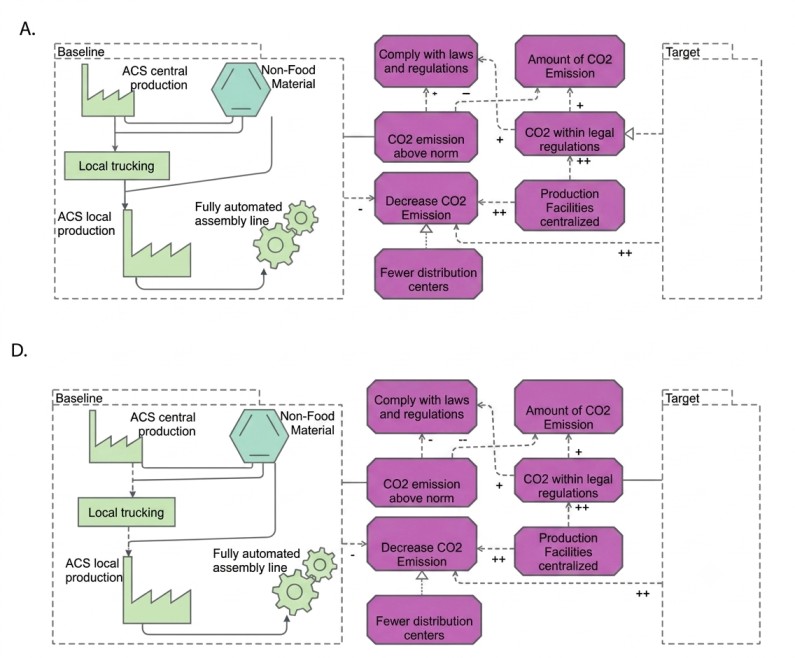
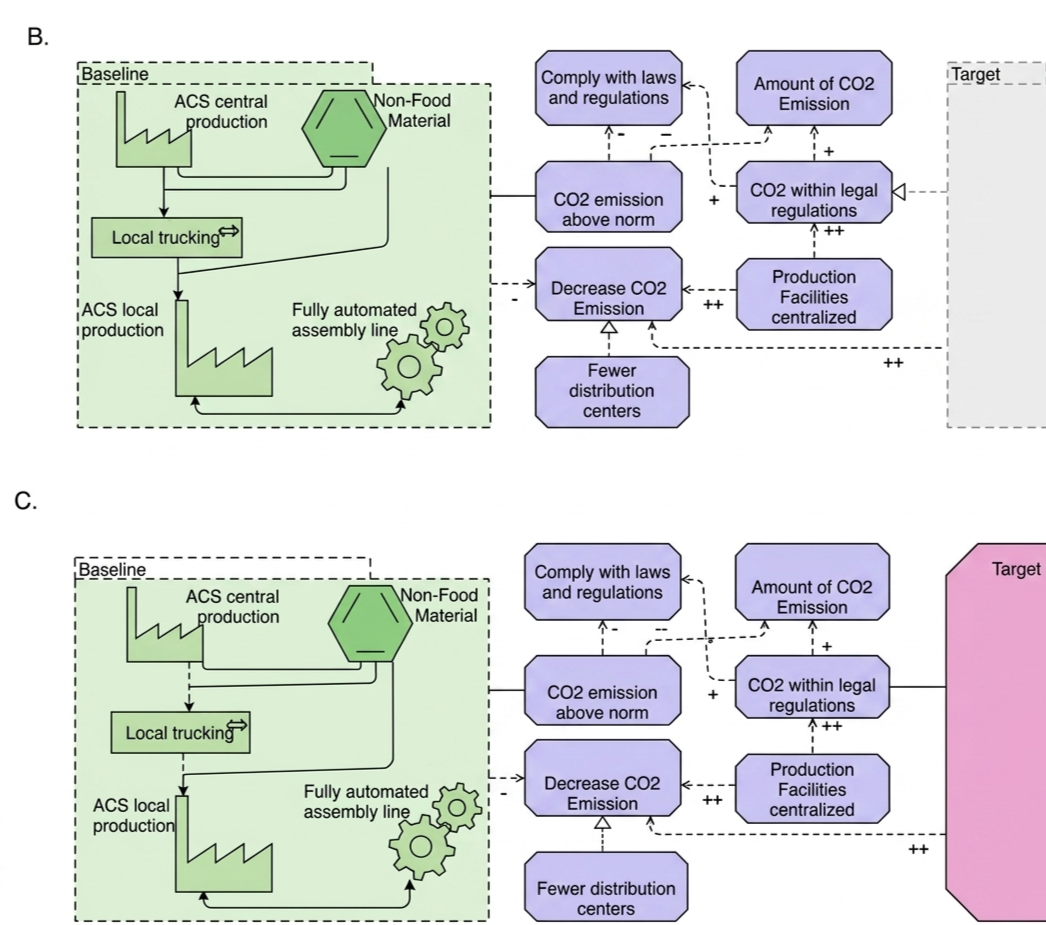
Correct Answer: D
Explanation:
The correct answer is D, as it best describes the transition from the baseline to the target state, including the motivation for changes based on the scenario. Here’s a detailed explanation of why D is the most accurate model: Baseline and Target: The Baseline state in all answers correctly depicts the current structure of ACS's operations, including the ACS Central Production, Local Trucking, ACS Local Production, and Fully Automated Assembly Line. D captures the essential transition from this baseline state to the target state by illustrating how the organization is aiming to decrease CO2 emissions, as required by the new regulations, and how they intend to centralize production facilities. Motivation for Changes (Decrease in CO2 Emissions): The CEO’s plan to reduce CO2 emissions is a critical driver for change. This is captured clearly in D, which shows the effects of Decreasing CO2 Emissions, Complying with Laws and Regulations, and Centralizing Production Facilities. The Ministry of Social Welfare and Health’s law mandating CO2 reductions is accurately reflected in D, showing compliance as part of the motivation. D also depicts the motivation to centralize production facilities, which helps reduce CO2 emissions and aligns with the internal report suggesting that fewer distribution centers can meet ACS's needs effectively. Business and Environmental Factors: The scenario also points out that passenger numbers have decreased due to rising ticket prices, which reduces the demand for non-food materials from ACS. This factor is linked to the centralization effort, as reducing the need for distribution centers can reduce costs while still meeting business needs. D reflects this by linking Fewer Distribution Centers and Centralized Production Facilities to both decreased emissions and operational efficiency. Compliance with Laws and Regulations: D shows a clear connection between compliance with CO2 Emission Laws and the Amount of CO2 Emissions generated by ACS, which is an essential driver of change in the scenario. The need to ensure that emissions are within the legal limit is modeled effectively in D, reflecting the scenario’s requirement to meet regulatory expectations by the end of the year. Centralization of Production: The scenario suggests that centralizing production is one way to reduce emissions and achieve operational efficiency. This is depicted clearly in D, where Production Facilities Centralized leads to both fewer distribution centers and a significant decrease in CO2 emissions. D links the motivation for fewer distribution centers to environmental sustainability (CO2 reduction) as well as operational improvements. Comprehensive ArchiMate® 3 Compliance: D aligns well with ArchiMate® 3 standards. It models the Motivation Elements such as goals (e.g., Decrease CO2 Emissions), assessments (e.g., CO2 Emission Above Norm), and requirements (e.g., Comply with Laws and Regulations) accurately. The relationships between these motivation elements are correctly depicted using ArchiMate® connectors like influences and associations, ensuring that the transition from baseline to target is clear and fully compliant with ArchiMate® 3 best practices. Conclusion: Answer D provides the best representation of the proposed transition, focusing on the motivations for centralization and reduction of CO2 emissions. It accurately reflects the scenario’s requirements, including legal compliance, environmental goals, and operational changes, all while following ArchiMate® 3 modeling standards.
Question 2
Please read this scenario prior to answering the question ArchiSurance has decided to leverage its financial expertise by offering defined contribution retirement plans. Each trading day, ArchiSurance submits consolidated mutual fund trading transactions to a stock exchange on behalf of its retirement plan participants. The daily mutual fund trading cycle consists of four key processes: Transaction capture, pricing, trading and reconciliation. Transaction capture consists of two sub-processes: manual exchange and loans and distributions (L&D). For transaction capture, retirement plan participants use an online account management application to enter manual fund exchange transactions. For L&D, plan participants use a separate application to enter requests. The L&D application determines whether the request can be fulfilled based on the mutual fund balances held in each plan balances and a set of business rules. Each day's captured manual exchange transactions accumulate in a transaction database. ArchiSurance contracts with a third-party information service to receive a file of mutual fund prices at the close of each trading day. The pricing application uses this file to convert captured transaction into trades, and then validates each trade against the mutual fund balances held in each plan. The pricing application generates a trade file with the minimum number of trades necessary. The trading application sends this file to an external trading service. When the trading application receives a confirmation file back from the trading service, it causes the reconciliation application to update the plan recordkeeping database. The account management and L&D applications are hosted on separate application server clusters. Each cluster is a physically separate host that runs application server software on a set of virtualized hosts. All of these applications use a database server infrastructure that is hosted on another separate cluster of virtualized servers also on a dedicated physical host. The pricing, consolidation, trading and reconciliation applications, however, are batch applications that run on the ArchiSurance mainframe computer. All application hosts are connected via a converged data center network (DCN), which also connects them to a storage area network (SAN) as well as a wide area network (WAN) that is used to communicate with the external trading service. The SAN includes two physically separate storage arrays, one of which holds data for all databases, and another that holds data for all files. Refer to the Scenario The systems analysts would like to better understand the business processes and applications for daily fund trading. You have been asked to describe the business processes and sub-processes, the applications that they use, the data objects accessed by those applications, and the external application services that access some of those data objects. Which of the following is the best answer? Note that you are not required to model the business actors/roles.
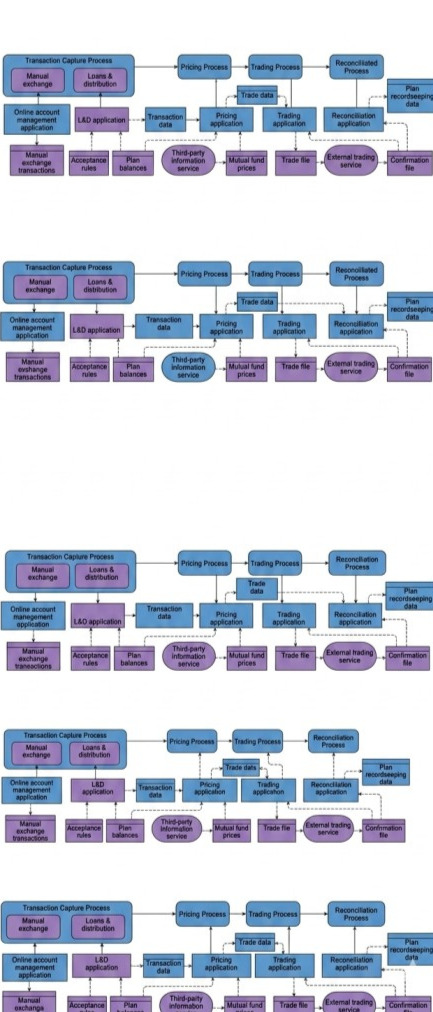
Correct Answer: B
Explanation:
In this scenario, the goal is to model the business processes, their sub-processes, the applications supporting these processes, and the data objects these applications access. Additionally, external services that access some of these data objects need to be shown. This includes capturing the key processes and their dependencies, as well as understanding how the applications interact with data and external services. Key ArchiMate® 3.2 Concepts Applied: Business Processes and Sub-Processes: Transaction Capture Process: Consists of two sub-processes: Manual Exchange Loans & Distribution (L&D) This process is responsible for capturing transactions from users through different applications (Online Account Management, L&D Application). Pricing Process: This process uses the Mutual Fund Prices from a third-party service and the Plan Balances to validate and price trades. Trading Process: This process generates a Trade File and interacts with an external Trading Service. Reconciliation Process: This final process updates the Plan Recordkeeping Data after confirming trades from the External Trading Service. Applications and Data: Online Account Management Application and L&D Application: These capture user inputs for transactions and maintain Transaction Data and Plan Balances. Pricing Application: Uses Mutual Fund Prices and Transaction Data to generate Trade Data. Trading Application: Submits Trade Data and receives a Confirmation File from the external Trading Service. Reconciliation Application: Uses the Confirmation File to update Plan Recordkeeping Data. External Application Services: Third-Party Information Service: Provides Mutual Fund Prices. External Trading Service: Processes trades and returns a Confirmation File. Data Objects: Transaction Data: Captured by the transaction capture processes. Mutual Fund Prices: Received from the third-party service. Trade Data: Generated by the pricing and trading applications. Plan Recordkeeping Data: Updated by the reconciliation process after trade confirmation. Why Option B is Correct: Option B provides the most complete and accurate representation of the scenario. It captures the business processes (Transaction Capture, Pricing, Trading, Reconciliation) and their sub-processes, while showing the appropriate connections to the applications that support these processes. It clearly depicts the data objects (Transaction Data, Plan Balances, Trade File, Mutual Fund Prices, Plan Recordkeeping Data) and their flows between the processes and applications. The model also includes the external services (Third-Party Information Service and External Trading Service), showing how these interact with the internal applications and data objects. It accurately represents the flow of Trade Data from the Pricing Application to the Trading Application, and the use of Mutual Fund Prices by the Pricing Process. Why Other Options Are Incorrect: Option A and Option D miss some critical connections between the applications and the external services. They also lack clarity in how the data flows between the processes and applications. Option C does not adequately represent the interaction between the applications and the external services (e.g., Third-Party Information Service), which is a key requirement in this scenario. Conclusion: Option B provides the best and most accurate description of the business processes, applications, data objects, and external services involved in ArchiSurance's daily fund trading operations, following ArchiMate® 3.2 standards for modeling business processes and applications.
Question 3
Please read this scenario prior to answering the question The ArchiSurance Mobile consumer solution is used for selling and renewing insurance products, providing customer service, enabling accurate and convenient home recordkeeping, and capturing and processing claims. The solution consists of three applications. The Consultant application lets customers review their existing coverage, and update it based on common life events, such as getting a new car, moving into a new home, or having a family member move in or out. If necessary, they can speak or chat with a customer service representative. The Home Manager application helps customers photograph and catalogue their valuable possessions in order to support the filing of accurate claims in case of loss or damage. The Claim Manager application enables customers to quickly file a claim for loss or damage to an insured auto, home or possession. It enables customers to describe the incident by referencing information captured with the Consultant and the Home Manager applications. In addition, it allows the customer to add photographs, audio, video and text to support a claim, submit the claim, and monitor its progress. The ArchiSurance Mobile applications rely on a number of application services hosted by ArchiSurance. The first is an Auto Identification and Description (AID) service that the Consultant application uses to validate and complete auto information entered by customers. The second service, Home Identification and Description (HID) performs the same function for home information, and is used by the Home Manager application. The Consultant application also uses the Virtual Agent service to guide customers as they select coverage options, the Payment Processor service to arrange premium payments, and the Coverage Activator service to generate policies and put them in force. ArchiSurance Mobile also relies on a number of technology services. The Home Manager application uses a Multimedia Repository service to store and retrieve information about insured homes. The Claim Manager application also uses this service for claim information entered by customers. All three ArchiSurance Mobile applications use a Personal Security service to register and authenticate customers, and to manage their profiles. Each application service is realized by an application component with the same name. Each technology service is realized by a system software environment, having the same name. ArchiSurance hosts both the application components and system software environments in a virtualized server pool within its data center. Each service has its own virtual server. Each virtual server is connected to a data center network (DCN) which in turn connects to a commercial wide area network (WAN). Refer to the Scenario You have been asked to show the applications that make up the ArchiSurance Mobile solution and the technology that supports these applications. Which of the following answers provides the best description? Note that it is not necessary to model
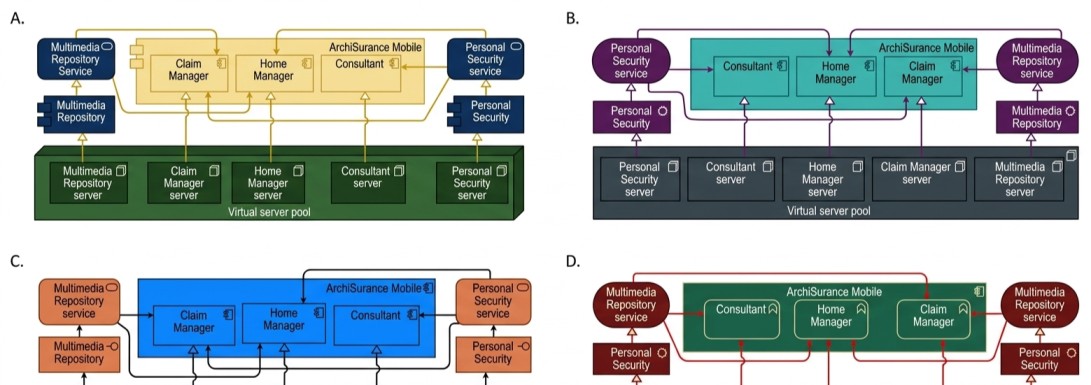
Correct Answer: C
Explanation: